Why Your Back Hurts After Long Drives — It's Not the Seat, It's Your Stillness
Why Your Back Hurts After Long Drives — It's Not the Seat, It's Your Stillness
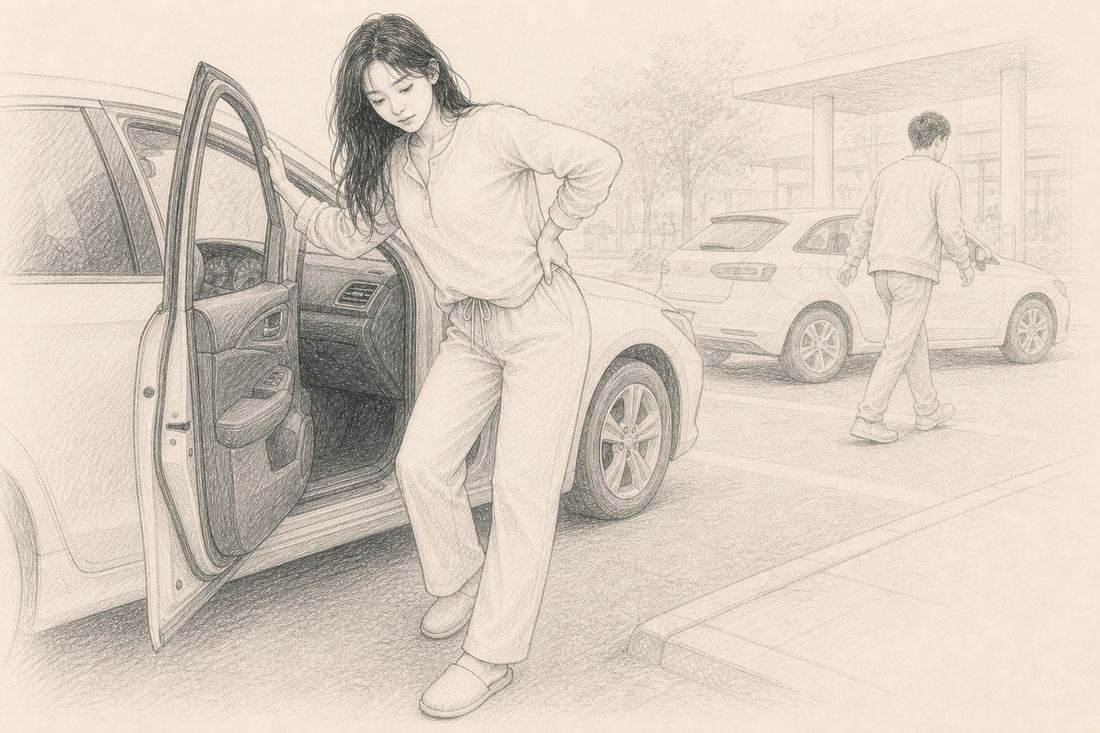
You pull into a rest stop after two hours on the road. The moment you reach for the door handle to step out, your lower back sends a warning signal before your feet even touch the pavement.
Just two hours. Yet your body feels like you've been sitting for days. You grip the car door, slowly straighten up, and notice someone next to you exiting without hesitation. It's a small thing, but it stings a little.
Monday morning after a long holiday weekend. You try to sit down at your desk, but your back won't fully straighten. A coworker asks, "Did you get hurt?" You weren't doing anything strenuous, yet here you are, moving like you're recovering from an injury.
"If your back hurts, fix your posture first," a friend suggests. It's not bad advice, so you adjust the seat position, buy a lumbar support cushion, try different angles. Two hours into your next drive, the result is identical.
If any of these three scenarios sound familiar, you're not alone.
So today, before you spend money on a new seat or cushion, let's talk about what you actually need to understand. Why posture correction alone doesn't solve driving-related back pain, and what actually works in real life.
Half of All Drivers Experience Back Pain Every Year
"Am I just unusually sensitive to this?" you wonder. Does driving really affect the back this much?
A meta-analysis of 19 studies involving 7,723 professional drivers tells a different story. The prevalence of back pain among professional drivers (taxi, bus, and truck drivers) is 39% in the past 7 days and 53% in the past 12 months. When I first saw that number, I was genuinely startled.
That's more than 3 times higher than the average for the general adult population in Western countries, which sits around 15%.
53% might not feel real until you think about it this way: if you work with 10 drivers, 5 of them experienced back pain at some point last year. That's the statistic.
Here's another important detail: this number doesn't include only people who went to the hospital, took time off work, or had severe pain. It includes anyone who answered "yes" to "Have you had back pain in the past 12 months?" The people who drive with mild discomfort, stiffness, or dull aches but push through? They're likely not even captured in this data.
If you drive frequently and experience back pain, it's not a personal weakness. It's the result of the structure you're putting your body in—whether it's your job or your lifestyle.
Why Changing Your Seat Doesn't Solve the Problem
It's easy to assume the seat is the culprit.
You buy a new seat, add a lumbar cushion, adjust the backrest angle. Still, two hours in, that familiar stiffness returns. After this cycle repeats, doubt creeps in. Is this really a seat problem? Or is my body just weak?
The answer is yes to both—but not in the way you think. It's not just the seat. Driving causes back pain because three factors combine simultaneously.
Sitting Itself Creates Pressure on Your Spine
So why does standing feel better? Is it just about posture?
The intervertebral discs—the cushioning tissues between your vertebrae, commonly called "discs"—experience higher pressure when you're sitting than when you're standing. Classic research confirmed this difference in healthy discs.
When you stand, your legs share your body weight. When you sit, that load concentrates on your lower back. That stiffness you felt after two hours of driving? That's what happens when this pressure persists.
However, research also shows that in degenerative discs—ones that have already worn down—the difference between sitting and standing pressure is minimal. This means adjusting your posture can't reduce disc pressure to zero. No matter how perfectly you set up your seat, if you're sitting for hours, there's a limit to what positioning can achieve. That's why seat adjustments alone fall short.
Long Sitting Shortens Your Hip Flexor Muscles
This is the most important factor in driving-related back pain, yet most people don't know about it.
A muscle runs from your thigh to your lower spine. Medical terminology calls it the psoas major, or hip flexor. When you sit, this muscle stays in a shortened, bent position. After an hour, two hours, or more, the muscle adapts to that shortened state.
Shortened hip flexors pull your pelvis forward. When your pelvis tilts forward, your lower back arches excessively, like a bow. To maintain this position, the muscles around your spine (like your erector spinae) stay in constant tension.
"I wasn't even thinking about my posture, so why is my back so stiff?" I thought the same thing. The answer lies here: your muscles are already shortened, and they're contracting repeatedly for hours.
Changing your seat won't fix this problem. As long as you're sitting for extended periods, these muscles keep getting shorter.
Driving Vibration Is Different From Regular Sitting
This final reason is what makes driving uniquely hard on your back.
While driving, vibrations from the engine and the road continuously transmit through your body. Research published in PubMed explicitly states that whole-body vibration causes mechanical overload on the lumbar spine and intervertebral discs, accelerating spinal degeneration.
This is why your back feels different after two hours in a car versus two hours sitting in an office chair. Vibration, sitting posture, and immobility all work together. That's why the seat alone isn't enough. The key is reducing sitting time itself and moving during breaks.
When to See a Doctor Before Reading Further
This article isn't a cure for back pain. So let me be clear about something first.
If you notice the following warning signs, see a healthcare provider before continuing. Persistent leg numbness lasting more than a week warrants professional evaluation.
If any of these apply to you, the doctor comes first:
- Leg numbness or tingling lasting more than a week
- Weakness or loss of strength in your leg or foot
- Difficulty controlling bowel or bladder function, or unusual sensations in that area
- Back pain accompanied by fever
- No improvement after 4–6 weeks of conservative care (rest, medication)
The American College of Physicians 2017 guidelines also recommend immediate professional evaluation when these red flag symptoms appear.
If you don't have these warning signs, the information below may help. However, no single method works for everyone. Try these approaches slowly and adjust based on your own condition.
Seat Setup: What to Check Before Buying Anything
Before investing in expensive cushions, there are free adjustments you can make.
When I started spending just 1–2 minutes checking these settings before driving, the difference after two hours became noticeable. Perfect posture won't eliminate pain, but it does reduce strain.
Seat Height
Adjust so your pelvis is level with or slightly higher than your knees. Your feet should reach the pedals comfortably with a slight knee bend. According to JOI Rehab, this position helps maintain the natural curve of your lower spine.
Backrest Angle
Don't make it too upright or too reclined. The goal is for your entire back to make light contact with the backrest. Avoid having your back float away from the seat or leaning so far back that your neck juts forward.
Lumbar Support
Position the lower part of the backrest where your lower spine naturally curves inward—your lumbar curve. If there's a gap, a lumbar cushion can fill it. Accuracy matters more than just adding padding anywhere.
Headrest
Adjust the height so the headrest supports the back center of your head, minimizing the gap between your neck and the headrest. According to Banner Health, proper headrest placement also reduces neck and shoulder tension.
Steering Wheel and Hand Position
Grip the wheel at a distance where your elbows bend slightly. Position your hands at the 9 and 3 o'clock positions. The key is preventing your shoulders from hunching up.
Remember this: the seat doesn't create good posture. It only reduces the strain of maintaining posture. After two hours of sitting, your back will feel tired regardless. Even with perfect seat setup, if you skip what comes next, you'll end up in the same place.
The Real Answer Is in the Break — Five Minutes at a Rest Stop
Honestly, stretching while driving isn't practical.
There's a limit to what you can do in a moving vehicle. The most realistic approach is to pull into a rest stop or service area and spend 5 minutes moving.
This is more effective than upgrading to a premium seat or buying a high-end lumbar cushion. I experienced the difference firsthand.
A randomized controlled trial from 2024 had participants perform active breaks targeting the lower back and hips every 30 minutes for 12 weeks. Pain intensity and discomfort decreased significantly. Sixty-four percent of participants reported overall improvement.
When I first read that result, I thought, "That's it?" But then it made sense. Your body wants movement, and you've been forcing it to stay still.
Stretching doesn't need to be lengthy. The Korean Rehabilitation Society recommends just 5–10 minutes daily is sufficient.
If you're a professional driver, here's something worth knowing: under labor law in many countries, you have the right to a 30-minute break after 4 hours of driving. When I first learned this, I realized how much accumulated strain came from not taking proper breaks. Actually taking these breaks became one of the most important things for back pain prevention.
Here are 4 movements you can do at a rest stop. No equipment needed, and you don't have to lie down.
Movement 1: Standing Gentle Back Extension
When to do it
Right after you get out of the car, while standing. This reverses the forward bend your spine has been in during the drive.
How to do it
Place your hands gently on your lower back. Slowly arch your back backward. You don't need to bend far. Repeat this gentle extension 5–8 times, returning to neutral each time. Stop if you feel pain.
Why it helps
You're reversing the forward flexion your spine has been in. Your shortened hip flexor muscles also get a gentle stretch in the opposite direction.
When I first tried this, I felt a difference within seconds. It's simple, but the effect is noticeable.
Movement 2: Single-Leg Hip Flexor Stretch
When to do it
After Movement 1. Especially helpful if you feel tightness in your thigh.
How to do it
Hold onto your car or a wall with one hand. Step one leg back and place the foot on the ground. Feel the front of your back leg's thigh stretch. Hold this position for 20–30 seconds. Repeat on the other side.
Why it helps
This targets the muscle that shortens the most during driving—the hip flexor that runs from your thigh to your lower spine. This shortened muscle is the main culprit pulling your pelvis forward and causing excessive lower back arch.
Movement 3: Standing Cat-Cow Variation
When to do it
When your entire lower back feels stiff and locked. When you want to gently mobilize your whole spine after vibration and pressure.
How to do it
Stand with feet shoulder-width apart. Bend your knees slightly. Place your hands lightly on your thighs. Round your spine like a stretching cat, then reverse the motion by pushing your chest forward and creating a gentle arch in your lower back. Repeat this flowing movement 5–6 times slowly.
Why it helps
This is a full-spine mobility movement you can do anywhere, even at a rest stop with no room to lie down. Your stiffened vertebrae get gentle movement after being compressed and vibrated.
Movement 4: 30-Second Walk + Deep Breathing
When to do it
When the other movements feel too elaborate, or when you're self-conscious about being watched. Even walking to the bathroom counts.
How to do it
Just walk. Thirty seconds to one minute is enough. While walking, breathe deeply—inhale from your belly up to your chest slowly, hold for 3–4 seconds, then exhale slowly. Repeat 2–3 times.
Why it helps
Walking gently decompresses your spine after being compressed during driving. Deep breathing relaxes the tense muscles around your lower back. It's the simplest and most accessible method.
You don't need to do all 4 movements. If you have 5 minutes, do all of them. If you only have 2 minutes, do Movements 1 and 4. Something is always better than nothing.
The Seoul National University Health Knowledge Center notes that early movement after acute back pain is recommended over prolonged bed rest. Staying in your car or lying down to rest isn't the only answer.
What to Do During Non-Driving Hours That Makes a Real Difference
Managing your back only while driving is too late.
For your next drive to feel easier, your body needs preparation during the hours you're not driving. So what should you do? These three things are worth starting today.
Walking
You don't need fancy equipment—just walking helps. The European Spine Journal's guidelines for chronic back pain management recommend exercise programs as first-line treatment. Walking has the lowest barrier to entry. In interviews with specialists, walking and swimming are recommended for spine-friendly exercise, with caution against overusing foam rollers too aggressively.
Sleep Position
Your back is affected even while you sleep. Sleeping face-down or on your side with your legs crossed is associated with back pain. When sleeping on your back, place a pillow under your knees to reduce lower back strain. When sleeping on your side, place a pillow between your knees to prevent pelvic rotation. I noticed my morning back pain improved after changing my sleep position.
About Age
Professional drivers over 41 are at higher risk for back pain. Age matters. After 50, muscle strength declines at an accelerated rate of 15% or more per decade. This is why back pain worsens with age. Building and maintaining strength early is far more efficient than trying to recover after problems develop.
A randomized controlled trial comparing 8 weeks of self-directed stretching exercises to professional physical therapy found both groups showed similar improvement in chronic back pain. If you thought "I can't afford professional treatment," this data might change your perspective.
You don't need to do everything. Pick the easiest one thing and start today.
Closing — At Your Next Rest Stop
This article isn't a cure for driving-related back pain.
It's written so your next long drive feels a little less daunting. So that moment when you pause before stepping out of the car at a rest stop becomes a little shorter.
Here's the summary: driving stresses your back not because of a bad seat, but because of three simultaneous factors—the pressure of prolonged sitting, hip flexor muscles shortening, and vibration. Good seat setup matters, but it's not the whole answer.
If your legs go numb, your feet feel weak, or you have bowel or bladder changes, see a doctor before anything else. If pain hasn't improved after several weeks, do the same.
If you do just one thing starting today, make it this:
Next time you pull into a rest stop, step out of the car, place your hands gently on your lower back, and do a gentle backward arch for 5 seconds. That's the starting point. Before the seat cushion, before the posture app, before anything else—just move.
I can't promise identical results for everyone. Bodies are different, and the same movement produces different responses in different people. But movement is always better than stillness.
References
- Professional driver back pain prevalence and risk factors (PMC11382477, meta-analysis of 19 studies, 7,723 participants)
- Sitting posture and disc pressure comparison (PMC8950176, meta-analysis)
- Psoas major (hip flexor) mechanism (PMC9464355)
- Whole-body vibration and spinal degeneration (PubMed 29240039)
- Professional driver occupational risk factors (PMC12240726)
- Active break intervention 12-week RCT, pain and disability reduction (PMC11660854, 2024)
- Self-directed stretching RCT (ScienceDirect S1836955323000176, 8 weeks, n=100)
- European chronic back pain management guidelines (PubMed 16550448, European Spine Journal 2006)
- Sleep position and back pain association (PubMed 40338112)
- Age-related muscle loss trajectory (PMC3940510)
- Seoul National University Health Knowledge Center — back pain management standards, early activity recommendation
- Labor law driving break requirements — 30-minute break after 4 hours of driving
- Korean Rehabilitation Society — 5–10 minute daily stretching recommendation
- American College of Physicians 2017 guideline — Red flag symptoms requiring immediate evaluation
- JOI Rehab — driving posture seat height adjustment standards
- Banner Health — headrest positioning guidelines
Medical Disclaimer: This article is for educational purposes only and should not replace professional medical advice. If you experience severe back pain, persistent numbness, weakness, or loss of bowel/bladder control, consult a healthcare provider immediately. Always consult with a qualified healthcare professional before starting any new exercise or treatment program.
— H.Sol, InsightOn BodyLab


댓글
댓글 쓰기